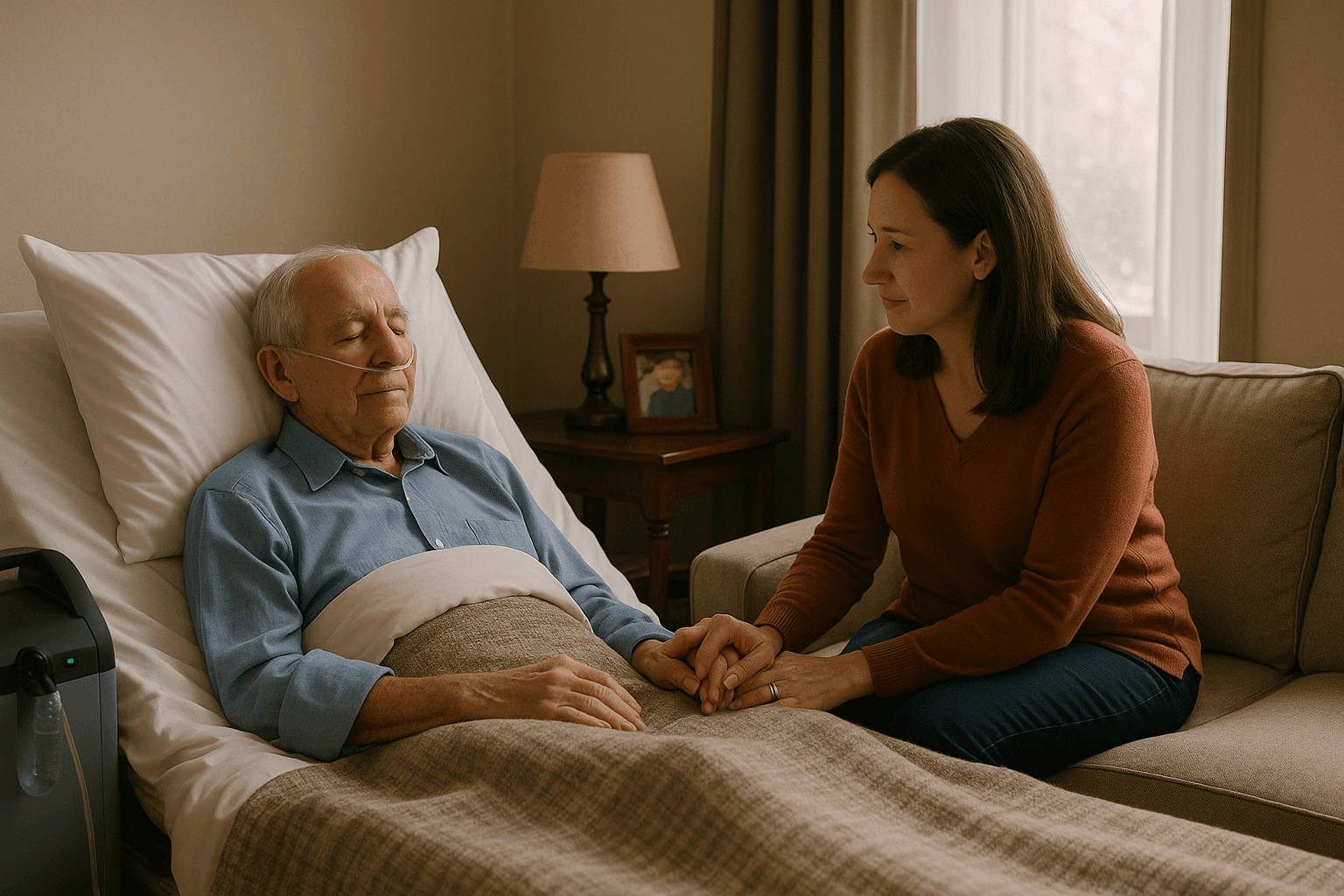

When the hospice nurse walked through Margaret Lawson's front door for the first time, her daughter Sarah felt something she hadn't expected: relief. Not the complicated, guilty kind of relief. Real relief. Finally, someone with medical training was going to be part of her mother's care. Someone who understood what was happening. Someone who could answer the questions Sarah had been too afraid to google at three in the morning.
Margaret had been diagnosed with advanced pancreatic cancer four months earlier. The oncologist had been honest, gently but clearly, about what the trajectory would look like. When Margaret decided to stop treatment and focus on comfort, the hospital connected the family with a hospice agency. Within days, a whole team materialized: a registered nurse who would visit twice a week, a certified nursing assistant for bathing three times a week, a chaplain, a social worker, a volunteer coordinator. The hospice team was excellent. Compassionate, professional, responsive. They answered every call. They adjusted medications when Margaret's pain spiked. They brought a hospital bed and oxygen equipment and showed Sarah how to use everything.
But here is the thing about hospice that nobody tells you until you're living it: the visits are short.
The nurse came twice a week and stayed sixty to ninety minutes each time. The CNA came three mornings a week for about forty-five minutes. The chaplain visited every other week. The social worker checked in by phone. Add it all up and you get maybe six to eight hours of professional support per week.
There are one hundred and sixty-eight hours in a week.
That left Sarah responsible for roughly one hundred and sixty of them.
The Partnership That Changes Everything
Nobody warned Sarah about the math. Nobody sat her down and said, "Hospice is essential and wonderful, and it will cover about five percent of your mother's care needs. You need a plan for the other ninety-five percent."
So Sarah did what most adult children do. She took FMLA leave from her job as a project manager. She moved into her mother's guest room. She set alarms on her phone for every three hours through the night - medication at midnight, a position change at three, another check at six. She learned to operate the oxygen concentrator, to change bed linens with her mother still in the bed, to prepare meals that Margaret could tolerate as her appetite disappeared.
For the first two weeks, adrenaline carried her. She was efficient, focused, running on love and determination and the unshakable belief that this was what daughters do. Her mother needed her, and she would be there. Period.
By week three, the cracks were showing. She forgot to give Margaret her afternoon medication. She burned dinner badly enough to set off the smoke alarm, which terrified her mother. She snapped at the hospice nurse during a visit, then burst into tears and apologized. She stopped returning calls from friends. She ate standing up over the kitchen sink, when she ate at all.
By week four, Sarah was making mistakes. Real mistakes. She mixed up medication doses. She let Margaret sit in a wet bed for two hours because she'd fallen asleep in the chair and didn't hear her mother calling. She caught herself, more than once, resenting her mother. Resenting the woman she loved most in the world for needing so much, for being so sick, for dying.
"That was the lowest point," Sarah said later. "Standing in the hallway at four in the morning, listening to my mom call my name, and feeling angry. Not sad. Angry. I hated myself for it. I thought something was wrong with me. I didn't know that's what happens when you try to do this alone."
It was the hospice social worker who finally said the words Sarah needed to hear: "You need more help. Not instead of what you're doing. Alongside it. Have you heard of Atlee Home Care?"
Sarah hadn't. She was skeptical. She'd looked into home care agencies before hospice started and had been put off by the cost, the impersonality, the idea of strangers cycling through her mother's house. But the social worker explained that Atlee was different - they connected families with independent caregivers who worked alongside the hospice team, filling in the gaps between visits.
Atlee Home Care works alongside hospice, not instead of it. This is a critical distinction that most families don't understand when they're first navigating the hospice world. Hospice provides the medical framework: pain management, symptom control, emotional and spiritual support, coordination with physicians. The Atlee team of independent caregivers provide the daily, hourly, practical support that makes it possible for someone to actually live at home during this time.
When Lori at Atlee spoke with Sarah, she asked detailed questions about Margaret's daily routine, her comfort preferences, her personality. She asked about the hospice schedule so they could coordinate rather than overlap. She asked about Sarah - how she was sleeping, what she needed most, what she was most afraid of.
"Nobody had asked me that," Sarah said. "What I was most afraid of. I said I was afraid of being asleep when my mom needed me. I was afraid of something happening in the middle of the night and not being there. That's why I wasn't sleeping. Not because of the alarms. Because of the fear."
Lori connected the family with Linda, an independent caregiver in the Atlee network who had extensive experience with end-of-life care and who understood how to work in partnership with hospice teams. Linda began providing overnight care four nights a week. She arrived at nine in the evening and stayed until seven in the morning. She handled the midnight medications, the position changes, the quiet moments when Margaret woke up disoriented and needed someone calm and familiar to remind her where she was.
Linda also used the Serenity app, Atlee's care coordination platform, to document everything that happened during her shifts. Medication times, food and fluid intake, pain levels, mood changes, sleep patterns. When the hospice nurse arrived for her twice-weekly visits, she had access to detailed notes about what had happened in the days between visits. When Sarah woke up in the morning, she could check the app and see exactly how her mother's night had gone.
"The first night Linda was there, I slept for nine hours," Sarah said. "Nine hours. I hadn't slept more than three consecutive hours in a month. I woke up and I felt like a different person. I went into my mom's room and she was clean, comfortable, and Linda was sitting next to her reading. And my mom looked at me and said, 'Good morning, sweetheart. Did you sleep well?' Like it was the most normal thing in the world."
What Sarah Discovered
Over the next six weeks, the shape of Margaret's care changed. The hospice team continued their visits, managing medications, monitoring symptoms, providing the medical expertise that only they could provide. Linda covered overnight shifts. Another caregiver in the Atlee network, James, came during the daytime on the days Sarah needed to handle errands, attend to her own medical appointments, or simply take a break.
And Sarah discovered something she hadn't thought possible: she could be her mother's daughter again.
She stopped being the person who changed the sheets and measured the morphine and set the alarms. She started being the person who sat on the bed and held her mother's hand and told her stories about the grandchildren. She brought photo albums and they looked through them together. She read to her mother from the mystery novels Margaret had always loved. She opened the curtains and described the garden, even as it went dormant for winter.
"I got my mom back for those last six weeks," Sarah said. "Not the healthy version of my mom. The real version. The one who was dying. But I was present with her in a way I couldn't be when I was trying to do everything. When Linda was there at night, I wasn't afraid to fall asleep. When James was there during the day, I wasn't afraid to leave the house. And when it was just me and Mom, I could actually be there. Not exhausted, not resentful, not terrified. Just there."
Margaret Lawson died on a Tuesday morning in February, in her own bed, in her own home. Sarah was beside her. Linda had been there through the night and had called the hospice nurse when Margaret's breathing changed. The nurse arrived in time. The chaplain came shortly after. Everyone who mattered was there, and everyone had a role, and no one had to do it alone.
"People tell me I'm strong," Sarah said, weeks later. "They say, 'You took such good care of your mom.' And I want to tell them: I almost didn't. I almost broke. The only reason I could be there for my mom at the end was because I finally let other people help me. The hospice team. Linda. James. Lori at Atlee. They didn't replace me. They made it possible for me to be the daughter my mom needed."
You Don't Have to Choose Between Professional Care and Family Time
Sarah's story is not unusual. Across Colorado, thousands of families are navigating the same impossible math: hospice provides essential medical support, but it covers a fraction of the hours in a day. Family members try to fill the gap, and they burn out. They get sick. They make mistakes. They lose the very relationship they're trying to protect.
It doesn't have to work that way.
The Atlee team of independent caregivers are experienced in working alongside hospice agencies. They understand the protocols, the terminology, the rhythm of end-of-life care. They communicate through the Serenity app so that everyone involved in a client's care - family, hospice, caregivers - has access to the same information. They provide the practical, daily support that makes it possible for someone to stay at home, comfortable and dignified, through the end of their life.
They also provide something harder to quantify but equally important: they give family members permission to rest. To sleep. To eat a meal. To step outside and feel the sun on their face for ten minutes without wondering what's happening inside. To be a son or daughter or spouse instead of a full-time caregiver.
If someone you love is on hospice and you're trying to do it all yourself, or if you're anticipating that hospice may be in your family's future and you want to understand your options, call Atlee Home Care at (720) 378-8708 or email contact@atleecare.com. Ask about how an independent caregiver can work alongside your hospice team. Ask about overnight care, weekend coverage, or whatever specific gap is keeping you up at night.
You don't have to choose between professional care and being present for your family. With the right support, you can have both.