
The phone call came on a Thursday afternoon in March. David Martinez was at his desk when Dr. Williams from Presbyterian/St. Joseph Medical Center asked if he had a moment to talk about his father.
Charles Martinez was 92 years old. He'd been in and out of the hospital three times in the past four months. Pneumonia, then a fall, then the pneumonia again, worse this time. David had watched his father, a man who'd built a landscaping business from scratch and raised three children after emigrating from Mexico at nineteen, become someone who needed help getting from the bed to the bathroom.
Dr. Williams was gentle but direct. "David, your father isn't going to get better. We've done what we can medically. It's time to talk about hospice."
David had known this was coming. Knowing didn't make it easier.
"I want to bring him home," David said. "He wants to be home."
What happened over the next three and a half weeks would be the hardest and most meaningful experience of David's life. And the support that made it possible came from two teams working together in a way David never expected.
Coming Home: The Reality Between Visits
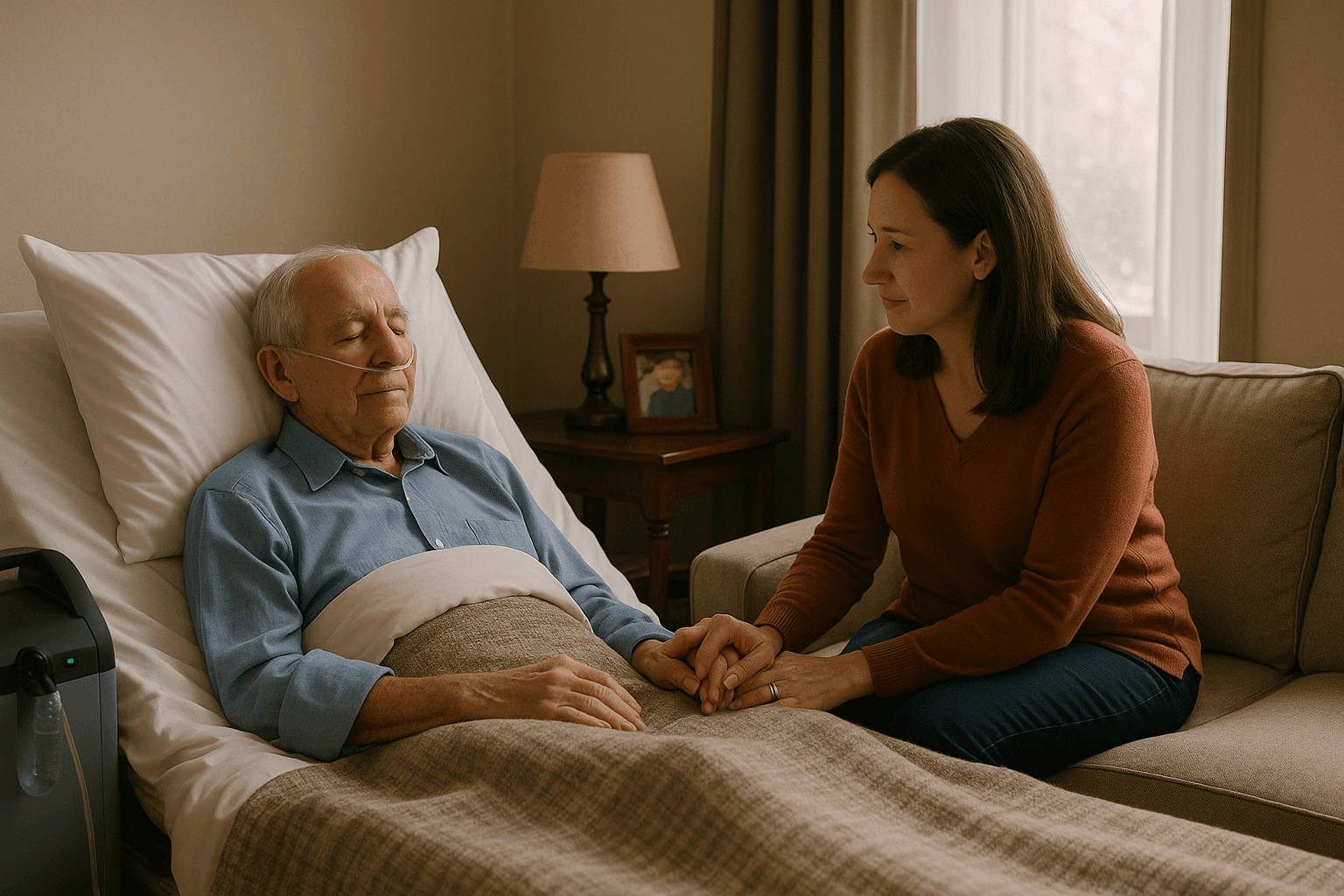
Charles came home to his Highlands Ranch house on a Saturday. The living room had been transformed: a hospital bed where the couch used to be, an oxygen concentrator humming in the corner, a folding table covered with medications, gauze, and supplies. The TV was angled so Charles could see it from the bed. His rosary was on the nightstand.
Hospice of the Foothills set everything up before Charles arrived. Their team was excellent. Sarah, the hospice nurse, would come twice a week to manage medications, assess Charles's condition, and adjust the care plan. A CNA would come three times a week for bathing, grooming, and basic physical care.
David was grateful. He was also quickly overwhelmed.
Because hospice, as wonderful as it is, isn't in your home 24 hours a day. Between Sarah's visits on Tuesdays and Fridays, between the CNA's visits on Monday, Wednesday, and Saturday mornings, there were long stretches of time when it was just the family.
David's sister Maria drove down from Fort Collins, ninety minutes each way. She stayed as long as she could, sleeping on the guest room bed, before driving home to her own family. David's brother Tom rearranged his work schedule, taking half-days and working evenings to be available during the day.
David himself took family leave from his job as an IT project manager. He thought he could handle it. He'd managed complex projects with dozens of moving parts. How hard could it be to take care of one person?
The answer came at 3:00 AM on the fourth night, when Charles needed to use the bathroom and David, who'd been sleeping on an air mattress next to the hospital bed, tried to help his father stand. Charles was unsteady. David was exhausted. They nearly fell together. David got his father to the bathroom and back to bed, but his hands were shaking afterward.
"We were all trying so hard to be caregivers," David said later, "that we forgot how to be his children."
When Sarah said what we were all thinking
It was Sarah, the hospice nurse, who said it out loud. She arrived for her Tuesday visit at the end of the second week and found David in the kitchen, eyes red, pouring his third cup of coffee at 9:00 AM. Maria was asleep on the couch, having driven down at midnight after Tom called to say he couldn't come the next day because his son was sick.
Sarah checked on Charles first. Then she came back to the kitchen and sat down across from David.
"How are you doing? Really."
David started to say "fine" and stopped. He was too tired to lie.
"I'm not sleeping. Maria's driving three hours a day. Tom's missing work. None of us know what we're doing. I'm scared I'm going to drop him or give him the wrong medication or miss something important."
Sarah nodded. She'd seen this before. Families who love fiercely but burn out quickly because they're trying to do everything themselves.
"David, I want to suggest something. Have you considered bringing in additional home care support? Not to replace what your family is doing. To supplement it. To fill the gaps between our visits."
David hesitated. "I thought hospice covered everything."
"We cover the medical care," Sarah explained. "Pain management, symptom control, medication adjustments, the clinical side. But the day-to-day, the being-there, the overnight support, the meals, the companionship, that's more than most families can sustain on their own. Especially when the person you're caring for is your father."
Sarah recommended Atlee Home Care. She'd worked alongside the Atlee team of independent caregivers before and knew they understood how to coordinate with hospice without stepping on toes or creating confusion. "They know what hospice does and what hospice doesn't do," she said. "They fill the space in between."
The Cost Conversation No One Wants to Have
David called Atlee at (720) 378-8708 that afternoon. He spoke with Lori, who listened to the entire situation before saying anything about services or pricing.
Then came the conversation David had been dreading: cost.
"I need to be honest with you," David told Lori. "I'm not sure we can afford this. Dad doesn't have long-term care insurance. His savings are modest. I'm on unpaid leave."
Lori walked David through the numbers carefully. The rate was $35 per hour. For 24-hour care, a typical day ran about $840. At first glance, those numbers felt impossible.
But then Lori asked David some questions he hadn't considered.
"What's your daily income?" David estimated roughly $500 a day in lost wages during his leave. "What's Maria spending on gas and wear on her car driving three hours a day?" About $150 a day in gas, tolls, and the wear and tear, plus the time away from her own job. "What about Tom's childcare costs when he rearranges his schedule?" Tom was paying about $200 a day for additional childcare to cover the hours he was spending at his father's bedside.
David did the math. The family was already spending $850 a day in lost income, travel, and childcare. They just weren't writing a check for it. The cost was hidden in paychecks not earned, gas tanks refilled, and babysitters hired.
And this was hospice, Lori gently pointed out. Not long-term care. They weren't planning for years of support. They were planning for weeks.
"This is the last gift you give your father," Lori said. "Let's figure out how to make it work."
They started with daytime coverage, twelve hours a day, to give the family relief during the hardest stretch. The plan was flexible: they could adjust up or down as Charles's condition changed.
Elena and the Atlee Team: Working Alongside Hospice
Lori connected Charles with Elena, an independent caregiver who had extensive experience working alongside hospice teams. Elena would be the primary daytime caregiver, arriving at 7:00 AM and staying until 7:00 PM. For overnight coverage, Lori connected the family with Rosa, another experienced member of the Atlee team of independent caregivers.
Elena arrived the next morning. She was calm, warm, and immediately competent. She introduced herself to Charles, who was having a good morning, and they discovered a shared love of old Westerns. Within an hour, Elena had John Wayne playing on the TV and Charles was smiling for the first time in days.
But what made Elena invaluable wasn't the companionship, though that mattered enormously. It was her understanding of the hospice framework.
Elena knew what fell under hospice's scope and what didn't. She knew not to adjust medications; that was Sarah's domain. She knew how to position Charles to prevent pressure sores, a task the CNA handled during visits but that needed attention throughout the day. She knew how to recognize changes in Charles's condition that should trigger a call to Sarah versus changes that were normal parts of the process.
On her first day, Elena created a simple communication log: a spiral notebook on the kitchen counter where she recorded Charles's food intake, fluid intake, medication times, pain levels, mood, and any concerns. When Sarah arrived for her next visit, the notebook gave her a complete picture of the days between visits. No guessing. No relying on the exhausted family's memory.
"This is exactly what we need," Sarah told David. "Elena's notes are more thorough than what most families can provide. This makes my job easier and your dad's care better."
The Partnership That Made the Difference
Over the following days, a rhythm developed. Sarah and the hospice CNA handled the medical and clinical care. Elena and Rosa handled the daily living, the companionship, the overnight vigilance, and the constant small acts of attention that kept Charles comfortable and safe.
The division of responsibility was clear:
- Hospice managed medications, pain control, symptom management, and medical equipment
- Elena and Rosa managed meals, hydration, positioning, hygiene between CNA visits, companionship, and overnight monitoring
- The family managed being Charles's children: visiting, talking, holding his hand, sharing memories, saying the things that needed to be said
That third role was the one David almost lost. Before Elena and Rosa, David was so consumed with the logistics of keeping his father alive that he didn't have the energy to be present with him. He was counting pills instead of telling stories. He was changing sheets instead of sitting beside the bed and listening to his father talk about his mother.
With Elena there during the day and Rosa through the night, David could walk into his father's room and just be David. He could sit in the chair beside the bed and talk about the Rockies. He could bring his father's favorite tamales from the restaurant on Broadway. He could hold his father's hand and not worry about what came next because someone competent and caring was handling it.
Maria could visit from Fort Collins twice a week instead of driving daily. She'd arrive rested, present, and able to spend quality time with her father instead of collapsing from exhaustion. Tom could keep his work schedule intact and visit in the evenings, bringing his son to see his grandfather.
The family got to be a family again.
The Final Days: When Expert Coordination Mattered Most
Two weeks into the arrangement, Charles's condition declined significantly. He was sleeping more, eating less, and having periods of confusion. Sarah adjusted his pain medication and increased her visits to three times a week.
Elena noticed the changes first. She documented everything in the notebook: decreased food intake over three days, longer periods of sleep, moments of agitation in the early evening. When Sarah arrived, she had a detailed record of exactly how Charles's condition had evolved since her last visit.
"Elena's documentation was critical during this period," Sarah said later. "In hospice, the transition from stable to actively declining can happen gradually, and having daily documentation from someone who knew Charles's baseline helped me make better clinical decisions."
David made the decision to expand to 24-hour coverage. Rosa, who had been doing overnight shifts three nights a week, moved to every night. Elena continued her daytime shifts. The family no longer had to worry about the 3:00 AM trips to the bathroom or the middle-of-the-night anxiety about whether Charles was breathing comfortably.
The coordination between Elena, Rosa, and Sarah became even more important during these final days. Elena and Rosa tracked pain indicators that Charles could no longer verbalize: facial grimacing, restlessness, changes in breathing. They reported these to Sarah, who adjusted medications accordingly. The goal was comfort, always comfort, and the three of them worked together seamlessly to achieve it.
Charles passed peacefully at home on a Tuesday morning in April. Elena was there. David was there, holding his father's hand. Maria had arrived from Fort Collins the night before, sensing it was time. Tom came straight from dropping his son at school.
Charles died in his own home, in his own bed, surrounded by his children, with John Wayne playing softly on the TV. It was exactly what he wanted.
Six Months Later: Looking Back
David sat down to calculate the total cost of Atlee's support six months after his father's passing. He's an IT project manager; he thinks in numbers.
Elena and Rosa provided care for 24 days total. The first two weeks were twelve-hour daytime coverage at $35 per hour: $420 per day, $5,880 for fourteen days. The final ten days were 24-hour coverage at $840 per day: $8,400. Transition days and adjustments added another $5,880 to the total.
Total cost: approximately $20,160 for 24 days of care.
"Twenty thousand dollars," David said. "People hear that and they think it's a lot of money. And it is. But here's what that money bought."
It bought Maria her sanity. She didn't have to drive three hours a day for three and a half weeks. At $150 per day, that would have been $3,600 in travel costs alone, plus the physical and emotional toll.
It bought Tom his job stability. He didn't have to take unpaid leave or pay for weeks of additional childcare. At $200 per day in childcare costs, that would have been $4,800.
It bought David his relationship with his father. Instead of spending the last weeks of Charles's life counting pills and changing sheets, David spent them having real conversations. His father told him stories about coming to America. About meeting David's mother. About the early days of the landscaping business. David recorded some of those conversations on his phone. He plays them back sometimes.
"You can't put a price on that," David said. "But if you forced me to, it was worth every penny of that twenty thousand dollars."
The Reality of Hospice Partnership
David's experience highlights something that many families don't understand about hospice until they're in the middle of it: hospice is essential, but it's not everything.
Hospice provides expert medical care, pain management, emotional support, and guidance through the end-of-life process. The hospice nurses, CNAs, chaplains, and social workers who serve Denver-area families are compassionate, skilled, and dedicated.
But hospice visits are scheduled. A nurse comes two or three times a week. A CNA comes a few times a week. Between those visits, the family is on its own. And for families dealing with a loved one who needs constant monitoring, overnight support, or simply someone present around the clock, the gaps between hospice visits can feel enormous.
That's where the Atlee team of independent caregivers can make a meaningful difference. Not by replacing hospice, which provides irreplaceable medical expertise, but by working alongside it. Filling the hours between visits. Providing the documentation that makes hospice visits more effective. Giving families the space to be families instead of exhausted, untrained caregivers.
The key is coordination. Elena and Rosa understood exactly where their role ended and Sarah's began. There was no confusion, no duplication, no stepping on toes. It was a partnership built on mutual respect and a shared goal: keeping Charles comfortable and surrounded by love in his own home.
When Additional Support Makes Sense
Not every hospice situation requires additional home care support. Some families have the numbers, the flexibility, and the stamina to cover the gaps between hospice visits. Some patients need less intensive monitoring. Every situation is different.
But there are common signs that a family might benefit from additional support during hospice:
- Family members are losing sleep because someone needs to be awake with the patient overnight
- The primary family caregiver is showing signs of burnout: exhaustion, irritability, inability to eat or sleep properly
- Siblings are traveling long distances and burning out on the commute
- The patient's care needs exceed what family members feel confident handling
- Family members are spending so much time on logistics that they don't have energy to be emotionally present
- There's disagreement among family members about who's doing enough, a common and painful dynamic that outside support can defuse
- The patient is declining and may need more consistent monitoring than scheduled hospice visits provide
If any of these resonate, it's worth having the conversation. Not after the crisis. During the process, while there's still time to make it better.
David's biggest regret is that he waited two weeks to call. "Those first two weeks were chaos," he said. "If I'd called Atlee on day one, those would have been two more weeks of being present with my father instead of two weeks of being his exhausted, panicked nurse."
The Gift of Complete Care
Charles Martinez came to America at nineteen with nothing. He built a business. He raised a family. He lived 92 years of a full, rich, stubborn, beautiful life. And at the end, he got to leave that life the way he wanted: at home, in his own bed, with his children around him.
That didn't happen by accident. It happened because a hospice team provided expert medical care. It happened because Elena and Rosa provided constant, compassionate daily support. It happened because David, Maria, and Tom were given the space to be children saying goodbye to their father instead of overwhelmed caregivers trying to do a job they were never trained for.
It happened because two teams worked together, each doing what they did best, so that Charles could do the only thing that mattered: be at home, surrounded by love, for as long as he had left.
If your family is navigating hospice and feeling overwhelmed by the hours between visits, you're not failing. You're experiencing what almost every family in this situation experiences. And there's support available that can work seamlessly alongside your hospice team.
Call Atlee Home Care at (720) 378-8708 or email contact@atleecare.com. Tell them about your situation. They'll listen, they'll understand, and they'll help you figure out what your family needs to get through this together.
Because the last weeks of a parent's life should be spent being their child. Not their nurse. Not their overnight aide. Their child.