
Robert spent forty-three years solving problems. As a structural engineer, he'd designed bridge supports that spanned rivers, calculated load distributions for buildings that touched the sky, and found solutions to challenges that other engineers had written off as impossible. He thought in systems. He planned in phases. He solved things.
So when a mild stroke at 81 left him with weakness on his left side, limited mobility, and a new dependence on a cane, Robert did what he'd always done. He engineered a solution.
He made lists. He designed systems. He calculated efficiencies. He created a recovery plan with the same precision he'd brought to forty-three years of structural analysis.
What he didn't account for was the one variable no engineer can fully control: the human body's refusal to follow a blueprint.
The Engineering Mindset Meets Reality
Robert's recovery plan was a thing of beauty. He'd laid it out on graph paper, because Robert still used graph paper, with timelines, milestones, and contingency plans. Morning routine: estimated 45 minutes. Meals: three per day, prep time 20 minutes each. Physical therapy exercises: twice daily, 30 minutes per session. Grocery shopping: once per week, Tuesday mornings.
The plan was logical. The plan was thorough. The plan was wrong.
Morning routine: estimated at 45 minutes, actually took 90. Getting dressed with one weakened arm took three times longer than he'd calculated. Buttons were adversaries. Shoelaces were enemies. The simple act of making a bed left him winded.
Meal prep: planned for 20 minutes, abandoned after 10 due to exhaustion. Standing at the counter for even short periods made his left leg tremble. Chopping vegetables with compromised grip strength wasn't just slow; it was dangerous. By the third day, he was eating cereal for dinner.
Physical therapy exercises: scheduled for twice daily, actually performed once, maybe. By evening, the fatigue was so heavy that the thought of doing another set of leg lifts felt like being asked to climb Everest.
Robert tracked all of this in a notebook, because he was an engineer and engineers track data. The data was telling him something he didn't want to hear. His plan wasn't working. His systems were failing. And for a man who had built his entire identity on solving problems, that was devastating.
The Moment Everything Changed
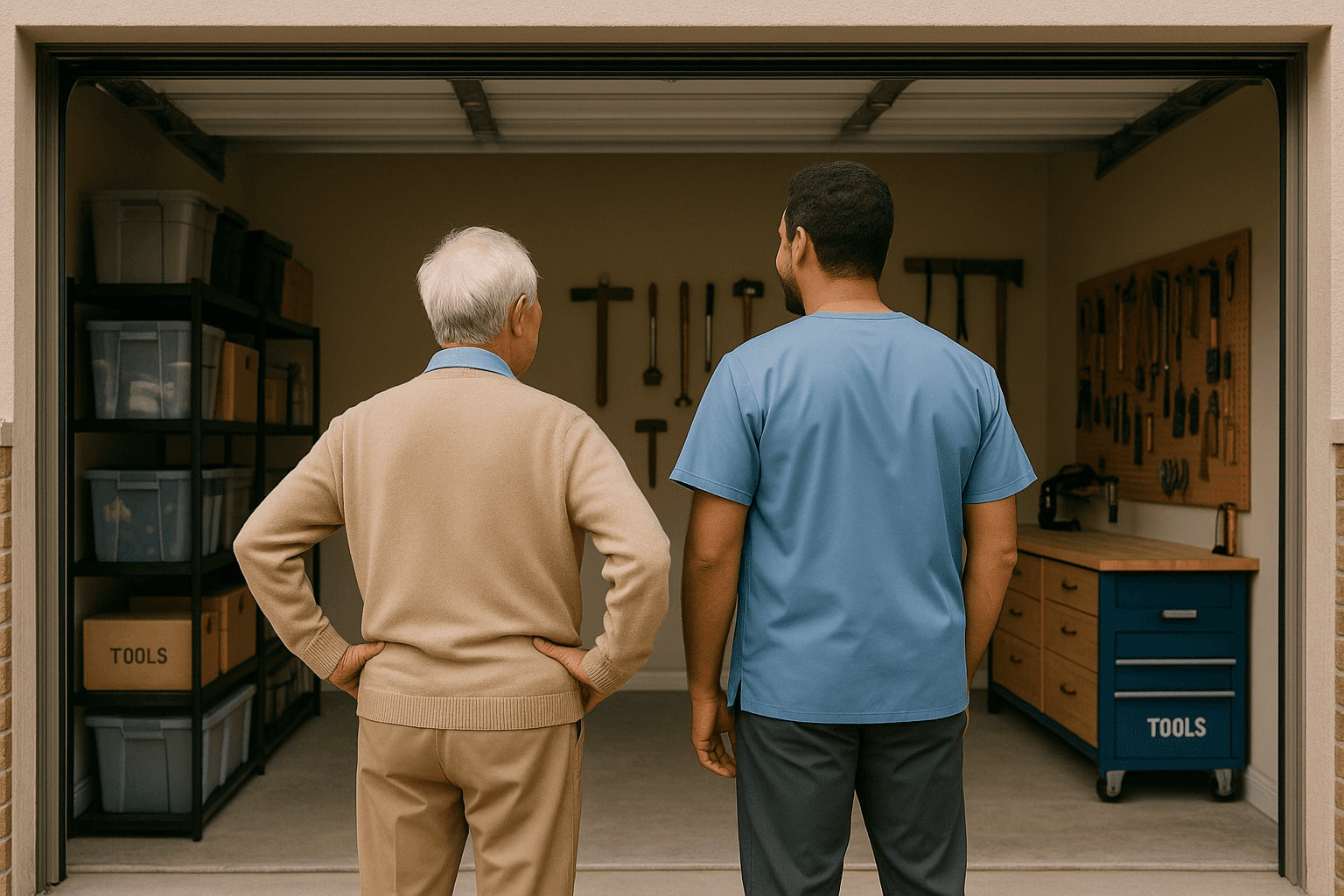
Three weeks after the stroke, Robert decided to organize his garage. This was his sanctuary, his workshop, the place where he'd spent thousands of hours building, fixing, and creating. He had every tool organized, every drawer labeled, every screw sorted by size and type.
He made it to the workbench. He pulled out a jar of screws that needed sorting. He sat down on a milk crate because standing wasn't an option anymore. And he tried to sort the screws.
His hands weren't steady enough. The small screws slipped from his fingers. The labels he'd written years ago were hard to read. Standing up to reach a higher shelf made him dizzy. After twenty minutes, he'd sorted maybe a dozen screws, and most of those had ended up in the wrong containers.
Robert sat on that milk crate in his garage, surrounded by the tools and projects of a lifetime, and felt something he hadn't felt in forty-three years of engineering: helpless.
He pulled out his phone and called his daughter Linda.
"I think I need help."
Three words. Five syllables. The hardest sentence Robert had ever spoken.
Why Those Three Words Are So Hard
For someone like Robert, saying "I need help" isn't just difficult. It feels like a contradiction of everything he is. He's a problem solver. He's the person other people come to when things are broken. He's the man who once redesigned an entire support structure at 2:00 AM because the original calculations were off by a fraction of a degree.
Asking for help, in Robert's mind, meant admitting failure. It meant his systems couldn't handle the problem. It meant he wasn't enough.
This is incredibly common among seniors, particularly men of Robert's generation. They grew up in an era that equated self-sufficiency with character. Needing help meant weakness. Asking for help meant giving up. The cultural script was simple: you handle your own problems.
But here's what Robert's engineering mind eventually recognized, sitting on that milk crate, surrounded by unsorted screws: the data didn't lie. His current system was failing. And a good engineer doesn't keep running a failing system out of pride. A good engineer redesigns.
Those three words -"I think I need help" -weren't an admission of defeat. They were the first step in a redesign.
The Difference Between Giving Up and Getting Smart
Linda had been waiting for that call. She'd been watching her father struggle for three weeks, biting her tongue, knowing that pushing him would only make him push back harder. Robert didn't respond to pressure. He responded to logic.
"Dad," she said carefully, "what would you tell a client who had a structure that wasn't performing to spec?"
Robert paused. He knew where she was going.
"I'd tell them to bring in additional resources," he admitted.
"Exactly. You're not giving up. You're bringing in additional resources."
It was the right framing. Not help. Resources. Not weakness. Strategy. Not failure. Optimization.
Linda called Atlee Home Care at (720) 378-8708 that same afternoon. She talked to Lori and explained the situation. Not just the stroke and the physical limitations. She explained Robert. His career. His pride. His engineering mind. His need to feel like he was still in charge of his own life.
Lori listened to all of it. Then she said something that Linda would remember for a long time: "I think I know exactly who Robert needs to meet."
The First Meeting: Speaking the Same Language
Lori connected Robert with Marcus, an independent caregiver who had spent twenty-five years as a construction foreman before transitioning to home care. Marcus had managed crews of fifty, coordinated with architects and engineers, and understood the language of building things.
The first meeting was carefully orchestrated. Marcus arrived at Robert's home on a Tuesday morning. Robert was sitting in his living room chair, arms crossed, wearing the expression of a man who had agreed to something he didn't want to agree to.
Marcus didn't start with a care assessment. He didn't pull out a clipboard. He walked into the living room, noticed the framed photos of Robert's projects on the wall, and stopped in front of a photograph of a bridge Robert had designed in 1987.
"Is that a Warren truss or a Pratt truss?" Marcus asked.
Robert looked up. "Modified Warren. The site conditions required additional lateral bracing."
They spent the first forty-five minutes talking about bridges, load calculations, and construction challenges. Marcus told stories about job sites where the engineers' plans had to be adapted in the field. Robert told stories about designs that pushed the boundaries of what was possible.
Eventually, Marcus said something that changed the entire dynamic: "Here's how I see this, Robert. You're the project manager. I'm a team member. Two people troubleshoot faster than one. I'm not here to take over. I'm here to help you optimize your systems."
Project manager. Team member. Troubleshoot. Optimize. These were Robert's words. Marcus was speaking his language.
Robert uncrossed his arms.
What 'Help' Actually Looked Like
Marcus started coming four mornings a week. But what he did bore no resemblance to what Robert had feared. There was no hovering. No condescension. No treating Robert like an invalid.
Instead, they worked together. Like colleagues on a project.
The kitchen was first. Robert's post-stroke kitchen was a disaster of workarounds: things stored on high shelves he couldn't reach, a stove he was afraid to use because his balance was unreliable, a refrigerator organized in a way that made sense before the stroke but not after.
Marcus and Robert redesigned the kitchen together. They moved everyday items to lower shelves and counter height. They organized the refrigerator so that the things Robert used most were at eye level. They set up a prep station at the kitchen table so Robert could sit while cooking instead of standing at the counter.
Robert drew up the plans. On graph paper, naturally. Marcus executed them. They debated shelf heights and drawer configurations the way engineers debate load specifications: with data, logic, and the occasional spirited disagreement.
The workshop was next. Robert's garage had always been his pride, but after the stroke, most of his tools were inaccessible. Marcus helped Robert reorganize everything so that the tools he used most were within reach from a seated position. They built a custom workbench at wheelchair height, even though Robert didn't use a wheelchair, because Robert believed in planning for contingencies.
"A good structure anticipates future loads," Robert said as they adjusted the bench height. Marcus grinned.
They also tackled the morning routine. Instead of fighting the 90-minute timeline, they redesigned it. Button hooks for shirts. Elastic laces for shoes. A shower bench and grab bars. A medication organizer that Marcus helped Robert fill each Monday. The new morning routine took 50 minutes. Robert tracked the data.
The Shift: From Patient to Partner
Something remarkable happened over the first month. Robert stopped seeing himself as a patient and started seeing himself as what he'd always been: an engineer working on a complex project.
The project just happened to be his own life.
With Marcus handling the physical tasks that Robert couldn't manage safely, Robert was free to focus on what he could do. He resumed working on a scale model bridge he'd been building before the stroke. He started reading technical journals again. He called former colleagues to discuss a new construction technique he'd read about.
He was engineering again. He was thinking again. He was Robert again.
The difference wasn't that Marcus did things for Robert. The difference was that Marcus did things with Robert. Every decision was collaborative. Every change was discussed. Robert was never overruled, never bypassed, never treated as anything less than the lead engineer on this particular project.
"Marcus doesn't work for me and I don't work for him," Robert told Linda one evening. "We're partners on a project. The project just happens to be keeping me functional."
Linda hadn't heard her father sound that energized in months.
What This Meant for Linda
Before Marcus, Linda was drowning. She lived in Aurora, about thirty minutes from Robert's home in Centennial, and she'd been spending every spare moment managing her father's needs. Grocery shopping, medication management, driving him to physical therapy appointments, checking in every evening to make sure he'd eaten.
She was also working full-time as an accountant and raising two teenagers. Something had to give, and what gave was Linda herself. She was exhausted, anxious, and carrying a constant low-grade guilt that she wasn't doing enough.
After Marcus started, Linda got her own life back. Not all at once, but gradually. She stopped doing the grocery shopping because Marcus and Robert had developed a system. She stopped the evening check-in calls because she knew Marcus had been there that morning and everything was handled.
More importantly, when Linda visited her father, she could be his daughter again. Not his caretaker. Not his project manager. His daughter. They could talk about her kids, his projects, the Broncos game. The visits were enjoyable again.
"I didn't realize how much the caregiving role had changed our relationship," Linda said later. "Dad and I were arguing all the time because I was trying to help and he was resisting. Once Marcus took over that role, Dad and I could just be us again."
That's something families don't always anticipate. When an adult child becomes a parent's caregiver, the relationship shifts. The parent-child dynamic inverts, and it's uncomfortable for everyone. Bringing in an outside partner, someone who isn't family, can restore the natural relationship and let everyone be who they're supposed to be.
The Lesson for Families
Robert's story illustrates something that families dealing with aging parents often learn the hard way: the conversation about help has to happen on the parent's terms, in the parent's language.
Linda didn't convince Robert by telling him he needed a caregiver. She convinced him by reframing it as bringing in additional resources for a project that was underperforming. It was the same thing, but the language mattered. The framing mattered. Respecting Robert's identity as an engineer, as a problem solver, as someone who was still in charge, mattered.
Every family has its own version of this. For a retired teacher, help might be framed as having a teaching assistant. For a retired business executive, it might be bringing on a staff member. For a retired chef, it might be having a sous chef in the kitchen.
The key is to find the language that preserves the person's identity and sense of control. People don't resist help because they're stubborn. They resist because they're afraid of becoming someone different. They're afraid that "I need help" means "I'm not me anymore."
The right framing says: You are still you. You're still in charge. You're just adding to your team.
Finding the Right Partner
Not every caregiver would have worked for Robert. Someone who came in with a clipboard and a care plan would have lasted about twenty minutes. Someone who treated Robert like a patient would have been shown the door.
What made the connection between Robert and Marcus work was intentionality. Lori at Atlee didn't just look at a list of available caregivers and pick the next one. She listened to Linda describe Robert: his career, his personality, his pride, his resistance. She thought about who in the Atlee team of independent caregivers would genuinely connect with a retired engineer who needed to feel like a project manager, not a patient.
Marcus was that person. His construction background gave him credibility in Robert's world. His temperament, calm, patient, collaborative, gave Robert space to adjust at his own pace. And his willingness to frame everything as a partnership rather than a service gave Robert back his sense of control.
This kind of matching doesn't happen by accident. It happens when someone takes the time to understand not just what a person needs, but who a person is.
If you're looking for this kind of thoughtful, personalized approach to home care in the Denver area, call Atlee at (720) 378-8708 or email contact@atleecare.com. The conversation starts with your parent's story, not a service menu.
Six Months Later: The New Normal
Six months after that phone call from the garage, Robert's life looked different. Not the life he had before the stroke, he knew that wasn't coming back. But a life that felt like his own.
He'd completed the scale model bridge. It sat on the shelf in his workshop, a perfect miniature of the first bridge he'd designed in 1974. Marcus had helped him build a custom display stand for it.
His morning routine was down to 48 minutes. He tracked the data religiously.
He'd started having lunch once a week with Jim, a former colleague, at a diner in Littleton. Marcus drove him and waited, sitting at the counter with a coffee, close enough if needed but far enough to give Robert his space.
And Robert had become something nobody expected: an ambassador for getting help.
He told his friend Jim about Marcus. Jim had been struggling since his wife passed and was too proud to ask for help. Robert put it in terms Jim could understand: "Getting help isn't weakness, Jim. It's strategic resource management. You wouldn't try to build a bridge without a full crew."
Jim called Atlee the following week.
Robert told his neighbor Paul, who was recovering from knee replacement surgery. Same framing: "You've got a project, Paul. Your recovery. You need a team member." Paul called too.
The man who couldn't say "I need help" six months ago was now telling everyone he knew that getting help was the smartest thing he'd ever done.
When 'I Need Help' Becomes Possible
Robert's story isn't unique, but the way it unfolded is instructive. The resistance wasn't stubbornness. It was identity protection. The breakthrough wasn't about overwhelming his objections. It was about reframing the entire concept of help in language that aligned with who Robert was.
If you have a parent or loved one who's struggling but resisting help, consider these approaches:
- Listen to their language. How do they talk about themselves, their career, their role in the family? Use that language when discussing help.
- Reframe, don't argue. "Bringing in a team member" feels very different from "hiring a caregiver," even if it's the same thing.
- Find the right match. The person matters as much as the service. A caregiver who connects with your parent on a personal level will be accepted far more readily than one who is clinically competent but personally mismatched.
- Give it time. Robert didn't warm up to Marcus in a day. It took weeks for the partnership to fully develop. Patience is essential.
- Let your parent lead. Even when they need help, they need to feel in control. Let them make decisions, set the pace, and define the terms.
Those three words -"I need help" -may be the hardest words your parent ever says. When they finally say them, make sure what comes next honors the courage it took to speak them.
The Atlee team of independent caregivers understands this. Every connection starts with understanding who your parent is, not just what they need. Call (720) 378-8708 or email contact@atleecare.com whenever you're ready. There's no pressure, no timeline. Just a conversation about what might help.