'Dad doesn't want a stranger in the house.'
Sarah had been saying it for months. To her husband, to her sister, to anyone who suggested that maybe her father, Frank, could use some help at home. She said it with the certainty of someone who'd heard it straight from the source. Because she had. Multiple times.
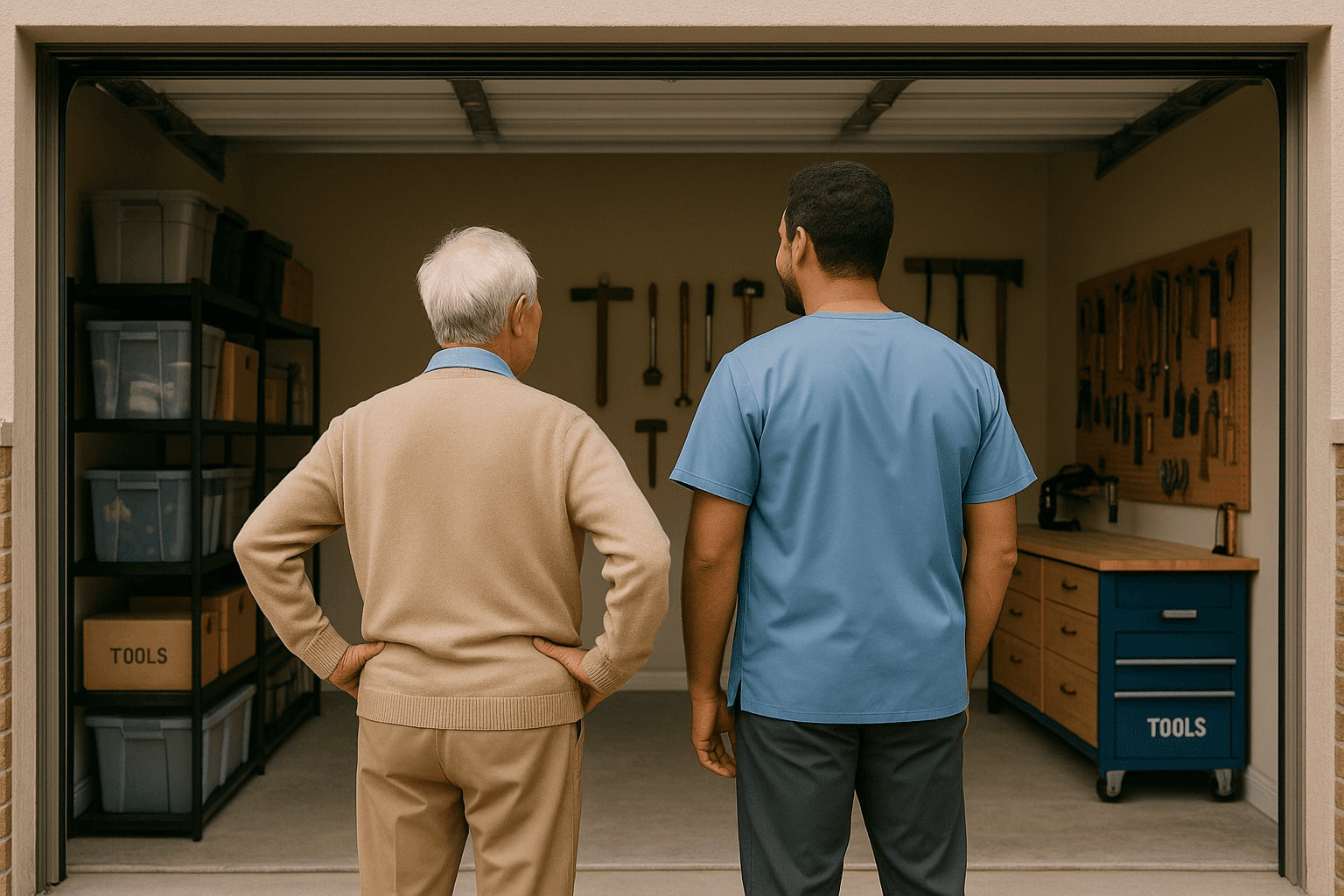
Frank was eighty-one. He'd been a machinist for thirty-four years, a Korean War veteran, a man who built his own deck, fixed his own car, and once set his own broken finger because, he said, the emergency room would take too long. He was not the kind of man who asked for help. He was the kind of man who would rather go without dinner than admit he couldn't manage the stove anymore.
But Sarah saw the signs. The unopened mail stacking up on the kitchen table. The same plaid shirt three days in a row. The way he'd gotten quiet, not just reserved the way he'd always been, but genuinely quiet, as if the effort of talking had become too much. The lawn, which Frank had mowed every Saturday for thirty years, was growing past his ankles.
She wasn't ready to force anything. But she wasn't ready to do nothing, either.
'Just try it once, Dad. For me.'
Frank didn't say yes. He said, 'Fine.' Which, for Frank, was as close to yes as anyone was going to get.
The Awkward Beginning
The first visit was a Tuesday morning. Sarah had arranged everything through Atlee Home Care. She'd called (720) 378-8708, explained the situation, described her father's personality in detail, because she knew the personality would matter more than the care plan, and asked them to connect her father with someone who could handle a proud, stubborn, eighty-one-year-old man who didn't want help and wasn't going to make it easy.
Atlee connected Frank with Tony, an independent caregiver who had a track record with exactly this kind of client. Tony was in his late forties, calm, built like someone who'd done physical work his whole life, and possessed of the kind of patience that doesn't come from training but from temperament.
Sarah was there for the introduction. She watched her father sit in his recliner with his arms crossed, barely acknowledging Tony's presence. Frank answered questions with one-word replies. Yes. No. Fine. He looked at Sarah with an expression that clearly said: I'm doing this for you, and I want you to know I'm not happy about it.
Tony wasn't fazed. He didn't try to win Frank over with cheerfulness or forced conversation. He moved through the house quietly, taking note of things without commenting on them. The grab bar that needed tightening in the bathroom. The throw rug in the hallway that was a fall waiting to happen. The kitchen, where the stove had a pot on it with something crusted to the bottom that had been there long enough to become furniture.
He made Frank a sandwich for lunch. Frank ate it without comment, which Sarah recognized as the closest thing to a compliment her father was capable of giving a stranger.
Before leaving, Tony pulled Sarah aside. He didn't report on the state of the house or list concerns. He asked one question.
'What does he love?'
Sarah blinked. 'What do you mean?'
'Your dad. What does he love? What gets him going? What does he talk about when he's in a good mood?'
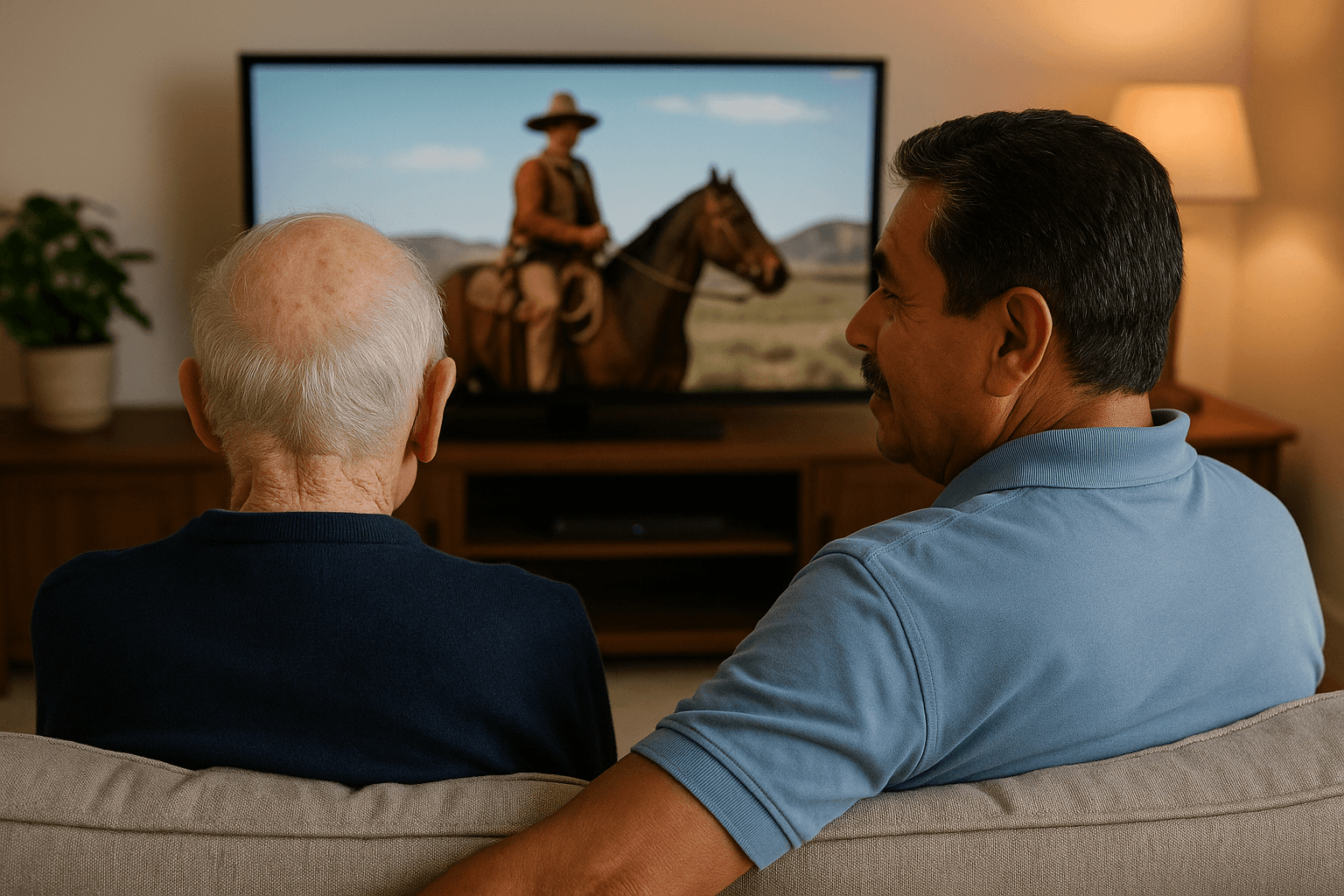
Sarah thought about it. 'Old western movies,' she said. 'John Wayne especially. He's seen every John Wayne movie ever made. Multiple times. He used to quote them at dinner when we were kids.'
Tony nodded. 'Good,' he said. 'That's good.'
The Conversation That Changed Everything
Sarah didn't know what Tony was planning. She went home that night hopeful in a cautious, don't-get-your-hopes-up way. The first visit hadn't been a disaster. That was the bar. It hadn't been a disaster.
She didn't expect what happened next.
Day Two: The Breakthrough
Tony came back on Thursday. This time, Sarah wasn't there. She'd thought about coming, hovering, making sure things went smoothly. But something told her that Frank might do better without an audience.
Tony arrived at ten. Frank was in his recliner, arms crossed, same position, same expression. The television was on but the volume was low. Some daytime show Frank clearly wasn't watching.
Tony set down his bag, sat in the chair across from Frank, and said: 'Mr. Frank, I heard you're a John Wayne fan. Mind if I ask, which one's your favorite?'
Frank's arms uncrossed. Just slightly.
'The Searchers,' he said. Then he paused. 'No. True Grit. The original, not the Coen Brothers one.'
'That's a good one,' Tony said. 'I'm a Man Who Shot Liberty Valance guy myself. Jimmy Stewart and John Wayne in the same movie, you can't beat that.'
Frank looked at Tony, really looked at him, for the first time. 'Liberty Valance,' he said. 'That's a real movie. Most people don't even know that one.'
What followed was two hours of conversation. Not small talk. Real conversation. Frank talked about watching The Searchers in a theater in 1956 when he was eleven years old. He talked about the summer he and his buddy drove to Monument Valley because they wanted to see where the westerns were filmed. He talked about taking Sarah and her sister to a John Wayne double feature when they were teenagers and both girls fell asleep.
He laughed. He laughed telling that story. Tony laughed too.
Tony did the dishes while they talked. He tightened the grab bar in the bathroom. He moved the throw rug in the hallway without mentioning it. He looked in the refrigerator and made a mental note of what was missing.
When Sarah called that evening, Frank answered on the second ring. He usually let it go to voicemail.
'That fella Tony,' Frank said. 'He knows his westerns. Did you know he's seen Liberty Valance eight times?'
Sarah sat down on her kitchen floor and put her hand over her mouth so her father wouldn't hear her cry.
What Happens When Trust Takes Root
Over the following weeks, something grew between Frank and Tony that neither of them would have called a friendship, because Frank didn't use words like that, but that's what it was.
They had a routine. Tony would arrive on Tuesday and Thursday mornings. They'd start with coffee, black for Frank, cream and sugar for Tony, a fact Frank found mildly offensive but had come to accept. They'd watch a western together, or at least have one on in the background while Tony handled tasks around the house.
The tasks expanded naturally, without Frank having to ask and without Tony having to push. Tony noticed that the lawn was overgrown and started mowing it. Frank watched from the window the first time. The second time, he came outside and stood on the deck, pointing out the spots Tony missed. By the third time, Frank was walking alongside the mower, not pushing it, but keeping Tony company.
They'd watch a western, then walk around the block. Just once around at first. Frank's balance wasn't what it used to be, and his right knee protested any distance over a few hundred yards. But Tony walked slowly, and he stayed on Frank's right side, the side with the bad knee, close enough to steady him if needed but not so close that it felt like assistance.
Frank started getting dressed before Tony arrived. Not just pulling on whatever was closest, but actually choosing a shirt, tucking it in, running a comb through his hair. He wouldn't have admitted this had anything to do with Tony's visits. He would have said he just felt like getting dressed.
Small things. But Sarah noticed every one of them.
The Gentle Progression of Care
Care needs don't arrive all at once. They creep in. And the beauty of the relationship Frank and Tony had built was that when new needs showed up, they didn't feel like defeats. They felt like natural next steps between two people who trusted each other.
Frank's arthritis flared badly one February morning. His hands were so stiff he couldn't manage his buttons. Tony helped him get dressed without making it a thing. He didn't say 'let me help you with that' in a pitying tone. He just reached over and did the buttons while continuing their conversation about whether Red River was overrated. Frank said it was. Tony disagreed.
When Frank's balance became more of a concern, Tony started helping him in the shower. This was the moment Sarah had dreaded most, the moment she thought would break her father's pride beyond repair. She'd imagined an argument, a refusal, a crisis.
What actually happened was simpler than that. One Thursday, Frank said his back was sore and he wanted a hot shower but didn't trust his footing on the wet tile. Tony said, 'I'll stand right outside the door. If you need a hand, just holler.' Frank hollered about three minutes in. Tony helped him with the same matter-of-fact calm he brought to everything. Afterward, they watched Rio Bravo.
By then, Tony wasn't a stranger. He was Tony. He was the guy who knew that Frank liked his coffee black, his steaks medium-rare, and his John Wayne films in chronological order. He was the guy who brought over a DVD of The Cowboys because he'd found it at a garage sale and knew Frank didn't have a copy. He was the guy Frank trusted enough to say 'I need a hand' without it feeling like surrender.
That trust didn't happen because of a care plan or a training module. It happened because someone at Atlee understood that connecting Frank with the right person mattered more than connecting him with the most qualified person on paper. Tony's qualifications were real and important. But what made the relationship work was John Wayne.
What This Meant for Sarah
Before Tony, Sarah was running on fumes.
She was driving to her father's house every day after work, sometimes during lunch. She was lying awake at 3 AM, staring at the ceiling, running through worst-case scenarios. What if he fell in the shower. What if he left the stove on. What if he went outside in January without a coat because he'd forgotten what month it was.
She was snapping at her husband. She was distracted at work. She was missing her own life because she was so consumed by managing her father's.
She wasn't caring for Frank. She was performing triage. Every visit was a scan for new problems: check the fridge, check the medications, check the floors for trip hazards, check Dad for signs that things had gotten worse since yesterday. It was exhausting, and it was making her visits feel clinical rather than familial.
After Tony started coming twice a week, the shift was gradual but unmistakable.
Sarah stopped waking at 3 AM. Not immediately, not completely, but the frequency dropped from five nights a week to one or two. She knew someone was checking on Frank. Someone who would notice if something was wrong.
She stopped rushing over every day. She still visited regularly, but now her visits were twice a week instead of daily, and they were different in quality. She wasn't scanning the house for problems. She was sitting with her dad, drinking coffee, listening to him talk about the western he and Tony had watched.
Her visits became about love, not logistics.
She started sleeping through the night. She started being present at her own dinner table. She started laughing at things that were funny instead of calculating whether she had time to laugh.
Her husband noticed. 'You're back,' he said one evening. He meant it as a compliment. She took it as the highest praise she'd received in months.
The Gift of the Right Match
Not every caregiver would have worked for Frank. Sarah knew that. Atlee knew that. That's why the matching process mattered so much.
If Frank had been connected with someone who was overly cheerful, he would have shut down. If someone had come in with a clipboard and a checklist, treating him like a patient instead of a person, he would have refused a second visit. If someone had tried to take over his house, reorganizing his kitchen or rearranging his living room, he would have shown them the door.
Frank needed someone who respected his pride. Someone who could be in his space without filling it. Someone who understood that helping Frank meant working alongside him, not for him. And someone who could find the entry point, the thing that would make Frank want to open the door, literally and figuratively.
John Wayne was that entry point. But it could have been anything. For another client, it might be gardening, or chess, or the Denver Broncos, or vintage cars, or baking bread. The point isn't the specific interest. The point is that the Atlee team of independent caregivers approach each person as an individual, not a case.
When you call Atlee Home Care at (720) 378-8708, one of the first things you'll be asked about is your loved one's personality. Not just their care needs, their personality. What makes them laugh. What makes them stubborn. What they used to love before they stopped doing it. What they talk about when they're at their best.
This information isn't a nice-to-have. It's the foundation of the entire relationship. Because the right caregiver with the wrong personality is still the wrong caregiver. And the right match, the one that clicks, can change everything.
You can also reach out by email at contact@atleecare.com if you'd like to start the conversation in writing. Some families find it easier to describe their loved one's personality and quirks in a message, where they can take their time and choose their words.
When 'I Don't Need Help' Becomes 'When is Tony Coming?'
It happened on a Saturday. Sarah was visiting Frank, sitting in the kitchen while he worked his way through a bowl of soup, when he looked up and asked: 'Is today Tony's day?'
It wasn't. Tony came Tuesdays and Thursdays. Frank knew that. Or he used to know that. The days were blurring a little, the calendar less reliable than it once was.
But the question wasn't really about what day it was. The question was: when is my friend coming back?
'Tuesday, Dad,' Sarah said. 'Tony comes Tuesday.'
Frank nodded. 'Good,' he said. 'I want to show him something. I found my old photos from Monument Valley. The ones from the trip with Eddie. Tony'll get a kick out of those.'
Sarah looked at her father, this proud, stubborn, eighty-one-year-old man who four months ago had crossed his arms and refused to make eye contact with the stranger in his living room, and she saw something she'd been afraid she'd never see again.
She saw her dad. Not a patient. Not a problem to solve. Not a crisis waiting to happen. Her dad. Excited about showing old photos to someone who would appreciate them.
'Is today Tony's day?' became Frank's favorite question. He asked it most mornings, even on days he knew the answer. It was his way of saying something he'd never say in those words: I have something to look forward to.
For families struggling with the decision to bring care into a loved one's home, Frank's story is a reminder that the beginning is almost always hard. The resistance is real. The awkwardness is real. The guilt, on both sides, is real.
But the beginning is just the beginning. What comes after, when the match is right, when the caregiver sees the person instead of the patient, when John Wayne opens the door that pride had locked, what comes after can be something none of you expected.
It can be joy.
If your father doesn't want a stranger in the house, we understand. Call us at (720) 378-8708 and tell us about him. Tell us what he loves. Tell us what he's stubborn about. Tell us about his John Wayne movies.
Then let us find his Tony.