
Last October, Patricia from Littleton was dreading winter. At 78, this would be her first Colorado winter since her husband Harold passed in June. Harold had always handled the storm preparations, the furnace checks, the driveway shoveling, and the dozen other things that turning a home into a fortress against a Front Range winter requires.
Patricia was healthy, sharp, and independent. She drove herself to the grocery store, kept up with her garden club, and talked to her daughter Sarah in Arvada twice a week. She wasn't someone who needed full-time care. She was someone who needed a partner to help her think through the things she'd never had to think through alone.
Maria, an independent caregiver connected through Atlee Home Care, came to Patricia's home twice a week. She helped with light housekeeping, some meal prep, and companionship. But what Maria did for Patricia that October went beyond any job description. Maria helped Patricia get ready for winter. And she did it not with expensive renovations or dramatic changes, but with the kind of quiet, observant attention that comes from someone who's in the home regularly and cares enough to notice what others miss.
The total additional cost of winterizing Patricia's home was under $50. The total peace of mind was immeasurable.
The Bedroom Rug That Had to Go
It started with a rug. Patricia had a decorative area rug in her bedroom, between her bed and the bathroom. It was a beautiful rug, a Persian-style pattern that she and Harold had bought on their anniversary trip to Santa Fe fifteen years ago. It had sentimental value. It also had a curled corner that Patricia caught her toe on one Tuesday morning in October.
She didn't fall. She stumbled, caught herself on the dresser, and went about her day. She didn't mention it to anyone.
But Maria noticed. The next time she was at Patricia's home, she saw the rug had shifted slightly, the way a rug shifts when someone's foot catches it. She asked Patricia about it, casually, without alarm.
"Oh, I just caught my toe on it the other morning," Patricia said. "It's nothing."
Maria didn't lecture. She didn't insist. She mentioned it to Patricia's daughter Sarah during their next check-in call. Sarah, who understood her mother's stubbornness and her attachment to the rug, handled it perfectly.
"Mom, I know you love that rug, but would you consider putting it away for the winter? When you're getting up in the middle of the night to use the bathroom, and it's dark, and your feet might be cold and stiff, a rug with a curled edge is exactly the kind of thing that could cause a fall. We can put it back in the spring."
Patricia agreed. The rug went into the closet.
Cost: $0. Time: 5 minutes. Risk eliminated: one of the most common causes of falls among seniors, tripping over loose rugs in bedrooms and bathrooms, especially during nighttime trips to the bathroom.
This is the kind of thing that falls through the cracks when someone lives alone. Patricia had walked past that rug every day for fifteen years. She didn't see it as a hazard. It took someone from outside her daily routine, someone who was paying attention with fresh eyes, to notice the risk.
Kitchen Reorganizing: Everything Within Reach
The kitchen was next. Maria had noticed something during her regular visits that concerned her: Patricia was using a small step stool to reach the cabinet where she kept her coffee mugs. The step stool was old, slightly wobbly, and Patricia was climbing on it first thing in the morning when she was stiff and not fully awake.
Maria watched Patricia do this twice without saying anything, noting how Patricia's balance wavered as she stepped up and how she gripped the counter edge while reaching overhead. On the third time, Maria asked a simple question.
"Patricia, would it be easier if we moved the mugs to a lower shelf?"
Patricia paused. She'd kept the mugs on that high shelf for thirty years because Harold liked them there. He was tall and preferred the upper cabinets for everyday items. After he passed, Patricia just kept everything where it was. She hadn't thought about whether the arrangement still made sense for her, living alone.
They spent an afternoon reorganizing the kitchen together. It wasn't a renovation. It was a rethinking.
- Coffee mugs, everyday plates, and glasses moved to eye-level cabinets
- Heavy pots and pans moved to lower cabinets so Patricia didn't have to lift overhead
- Daily medications moved from a high shelf above the sink to a designated spot on the counter
- The step stool was moved to the garage. Patricia could ask for help if she needed something from a top shelf during Maria's visits
- Frequently used spices and cooking supplies moved to a lazy Susan on the counter instead of a high spice rack
The entire reorganization took about two hours. The cost was zero. Nothing was purchased; everything was simply relocated to be safer and more accessible.
"I didn't realize how many times a day I was stretching and straining for things," Patricia said afterward. "I just did it because that's how the kitchen had always been. It never occurred to me to change it."
This is a pattern Maria sees regularly. When a spouse passes, the surviving partner often keeps the home arranged for two people. Cabinets organized for someone six feet tall don't serve someone who's five foot three. A garage set up for someone who maintained the cars doesn't make sense for someone who doesn't. The home becomes a museum to the old arrangement, and the person living in it adapts around it rather than adapting it to their current needs.
Storm Preparedness: Simple Peace of Mind
Colorado winters are beautiful, but they're also unpredictable. A sunny 60-degree day in October can be followed by a blizzard in November that drops two feet of snow and knocks out power for hours. Harold had always kept the house ready for storms: flashlights charged, batteries stocked, a weather radio on the kitchen counter, extra blankets accessible.
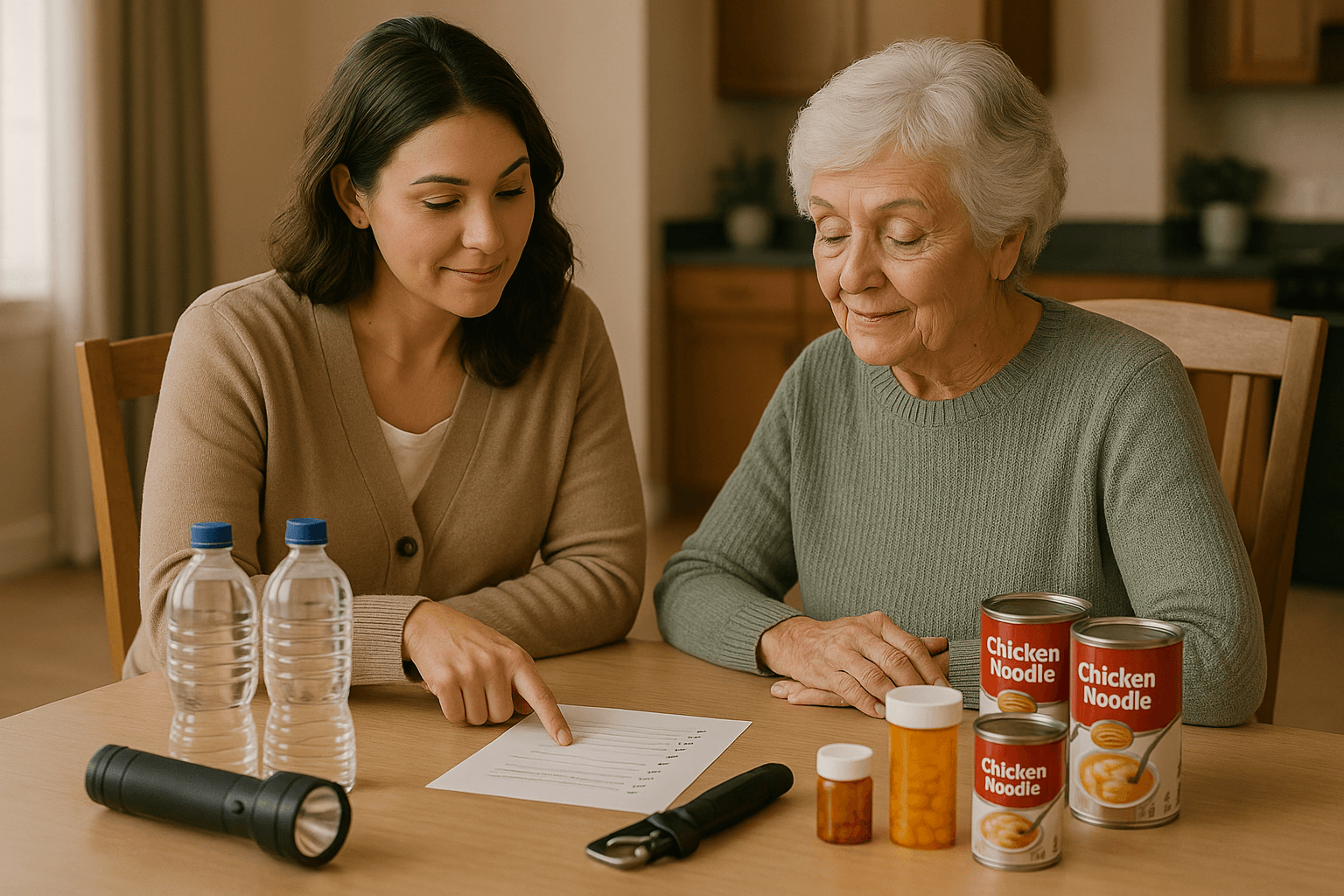
Maria suggested they do a storm preparedness inventory together. Not a military-grade emergency kit. Just a simple check of what Patricia had and what she might need.
The inventory revealed some gaps:
- Flashlights: Patricia had two, but neither had working batteries. They'd been sitting in a drawer since Harold's time and had never been refreshed.
- Battery-operated radio: Patricia had one, but it was in the basement on a high shelf she couldn't reach safely.
- Can opener: Patricia had an electric one, which would be useless in a power outage. She didn't have a manual backup.
- Extra medications: Patricia had a three-day supply, but a major storm could potentially make roads impassable for longer.
- Warm blankets: They were stored in a cedar chest in the spare bedroom. Accessible, but Patricia hadn't checked them in over a year.
- Bottled water: None on hand.
Sarah, Patricia's daughter, made one shopping trip to cover the gaps. The total cost was about $40: batteries, a manual can opener, a pack of bottled water, and a simple LED lantern. Patricia's doctor was able to adjust her prescription schedule to keep a seven-day buffer of medications on hand.
Maria helped Patricia set up a small storm station in the hall closet near the living room: flashlight, lantern, radio, batteries, and the manual can opener, all in one place, at a height Patricia could reach easily. They taped a small card to the inside of the closet door with emergency numbers: Sarah's cell phone, the neighbor's number, the power company, and Atlee Home Care at (720) 378-8708.
"Harold always handled this," Patricia said as they organized the closet. "I never had to think about it. I didn't even know where he kept the flashlights."
This is another common pattern after a spouse passes. One partner handled certain responsibilities for so long that the other partner never learned the system. It's not a failing; it's just how many marriages work. But when that partner is gone, the knowledge goes with them, and what's left is a gap that can become dangerous in an emergency.
The Communication Plan
The final piece was communication. If a storm knocked out power, or roads became impassable, or Patricia had an emergency, who would she call? In what order? How would people check on her?
Maria sat down with Patricia and created a simple communication plan:
- During severe weather, Sarah would call Patricia every morning by 9:00 AM and every evening by 7:00 PM
- If Patricia didn't answer, Sarah would call the neighbor, Janet, who lived two doors down and had a key
- If Janet couldn't reach Patricia either, Sarah would call Atlee at (720) 378-8708 or email contact@atleecare.com
- Patricia's cell phone was programmed with all key numbers on speed dial
- Janet had Patricia's daughter's number and knew about Patricia's medications and health conditions
Maria also helped Patricia practice using her cell phone for calls and texts. Patricia had a smartphone that Sarah had bought her, but she mostly used it for calls and had never sent a text message. Maria showed her how, patiently, over several visits, until Patricia could text Sarah confidently.
"I felt silly at first," Patricia admitted. "A 78-year-old woman learning to text. But Maria made it feel normal. She didn't talk down to me. She just showed me, step by step, and let me practice."
The communication plan cost nothing. The peace of mind it gave both Patricia and Sarah was significant. Sarah no longer lay awake during snowstorms wondering if her mother was okay. She knew the plan. She knew the neighbors were aware. She knew Patricia could reach her.
The Results: From Dreading to Ready
By December, Patricia's home was winter-ready. Not because of any major renovation or expensive upgrade. Because someone who was there regularly, who understood Patricia's daily life, who paid attention to the small things, helped her make a series of simple, inexpensive adjustments.
The complete winterization summary:
- Bedroom rug removed: $0, 5 minutes
- Kitchen reorganized: $0, 2 hours
- Storm supplies purchased: approximately $40, one shopping trip
- Medication buffer established: $0 (insurance covered the adjusted schedule)
- Communication plan created: $0, 30 minutes
- Cell phone training: $0, practiced over several regular visits
- Emergency numbers posted: $0, 10 minutes
Total additional cost: under $50. Total time beyond Maria's regular visits: approximately 3 hours spread over several weeks.
Patricia made it through that winter without a single incident. She didn't fall. She didn't run out of medications during a storm. She didn't panic when the power went out in January because she knew where the flashlight was and she could text Sarah to let her know she was fine.
"I went from dreading winter to feeling ready for it," Patricia said in February. "And the funny thing is, nothing really changed. I'm in the same house. I have the same things. We just rearranged a little and planned a little. That's all it took."
What Made the Difference: Someone Who Notices
The real value of what happened in Patricia's home wasn't the rug removal or the kitchen reorganization or the storm kit. Those were just actions. The real value was having someone in the home regularly who cared enough to notice things that Patricia couldn't see herself.
When you live in a space every day, you develop blind spots. The curled rug corner that you step over automatically. The cabinet that requires a step stool but you've been using that step stool for twenty years so it feels normal. The flashlight in the drawer that hasn't worked in three years but you never think about it until the power goes out.
Maria saw Patricia's home with fresh eyes, but not the fresh eyes of a stranger who visits once. The fresh eyes of someone who came twice a week, who understood Patricia's routines, who knew her habits and her history, and who could identify the gap between how Patricia experienced her home and how safe that home actually was.
This is something that fall-prevention checklists and safety audits can't fully replicate. A checklist can tell you to remove loose rugs. It can't tell you that this particular rug has sentimental value and that the best approach is to frame its removal as temporary and seasonal. A checklist can tell you to keep emergency supplies accessible. It can't sit with you over multiple visits and patiently teach you how to send a text message to your daughter.
The human element matters. Not just the tasks, but the relationship. Not just the what, but the how.
Patricia didn't feel like she was being managed or inspected. She felt like she had a partner. Someone who respected her independence while quietly helping her maintain it. That's a distinction that makes all the difference, especially for seniors who are fiercely independent and resistant to anything that feels like being taken care of.
The Real Value: Preparation Without Panic
Patricia's story doesn't involve a dramatic emergency or a close call. Nobody called 911. Nobody fell. Nobody ended up in the hospital. And that's exactly the point.
The best outcomes in senior home safety are the ones where nothing happens. Where the fall didn't occur because the rug was removed. Where the power outage wasn't a crisis because the flashlight worked. Where the snowstorm didn't cause panic because there was a plan.
Prevention doesn't make for dramatic stories. But it makes for safe winters, peaceful nights, and daughters who don't lie awake worrying during every storm.
If you have a parent or loved one in the Denver area who's facing their first winter alone, or who's been managing alone but showing signs that things are getting harder, the time to prepare is now. Not after the first snowfall. Not after the first fall. Now.
The adjustments are usually simple. The cost is usually minimal. What's required is someone who's there regularly, who's paying attention, and who cares enough to say, "Have you thought about moving those mugs to a lower shelf?"
The Atlee team of independent caregivers includes people like Maria: observant, thoughtful, respectful of independence, and skilled at the kind of quiet prevention that keeps seniors safe in their own homes. Not by taking over. By noticing. By suggesting. By partnering.
Call (720) 378-8708 or email contact@atleecare.com to start the conversation. It doesn't have to be complicated. Sometimes the most important thing you can do for a parent is make sure the flashlight works and the rugs are flat.