
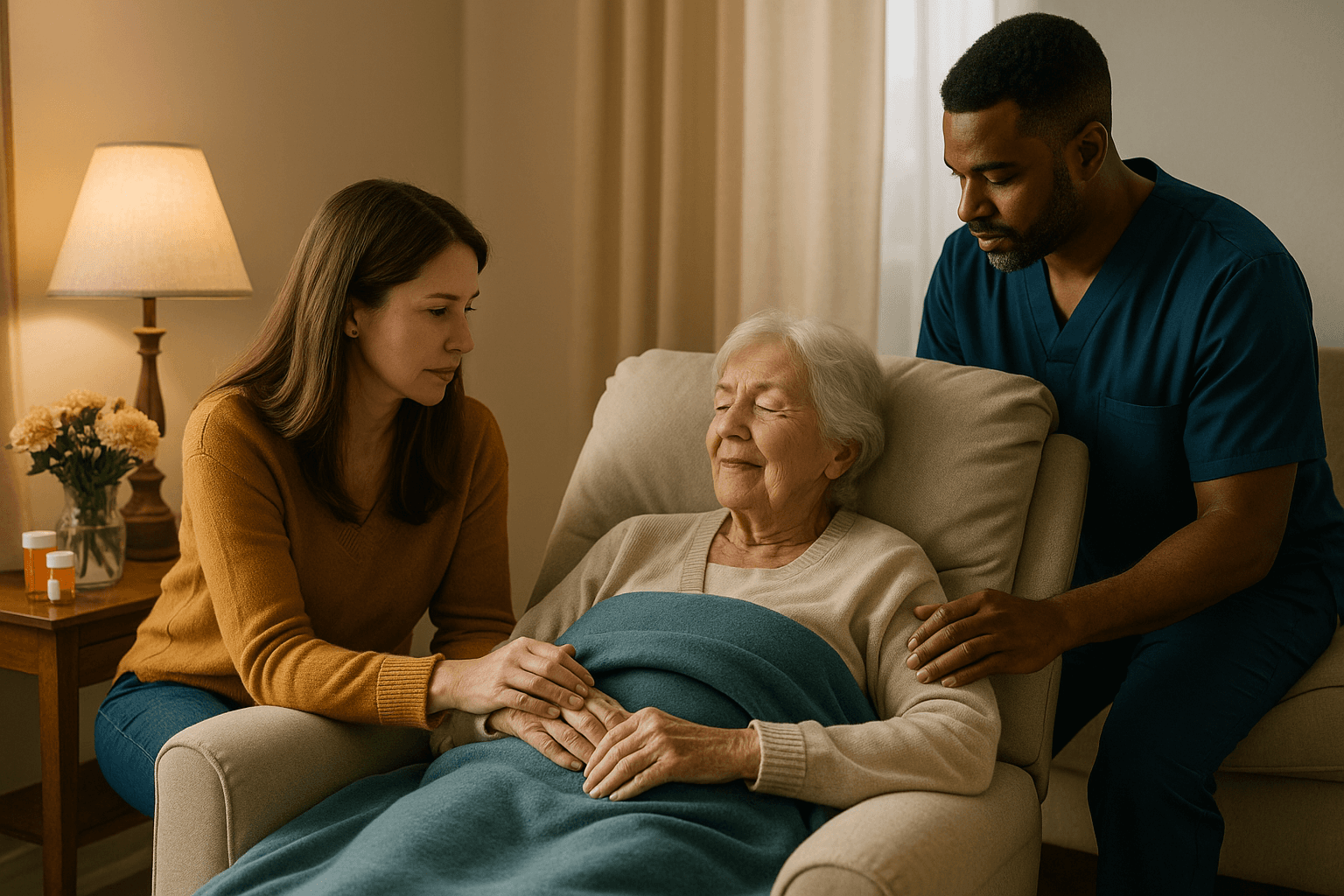
Sarah Henderson called Atlee Home Care three weeks before Christmas. Her voice was tight, the kind of tight that comes from months of holding everything together. Her mother Dorothy, eighty-one years old and living with Parkinson's disease, had hosted Christmas dinner for the Henderson family for forty years. Every year, the same dining room table. The same china. The same conversation about whether the gravy needed more pepper. But this year was different.
Dorothy's tremors had worsened over the summer. She'd fallen twice in October. By November, she needed help with most daily tasks - getting dressed, bathing, moving safely from room to room. Sarah had been driving over every morning and evening, fitting care around her own job and her two teenagers. Her husband was patient, but the strain was showing everywhere.
"I just want my mom to have Christmas," Sarah told Lori when she called. "But I can't do it alone anymore. I physically cannot cook a meal, watch my mother, and be present for my kids at the same time. Something has to give, and I refuse to let it be Christmas."
Lori listened. She asked about Dorothy - what she loved, what made her anxious, what her days looked like. She asked about the family dynamics, who would be there, what mattered most. And then she connected the Hendersons with Maria, an independent caregiver in the Atlee network who had years of experience supporting clients with Parkinson's disease and who genuinely loved the holidays.
The Morning Everything Felt Wrong
Maria arrived at Dorothy's house at nine o'clock on Christmas morning. She came in through the side door, carrying a small bag with her things for the day and a plate of cookies she'd baked the night before. Sarah met her in the kitchen, feeling the full weight of the awkwardness she'd been dreading.
There was a stranger in their kitchen on Christmas morning.
It didn't matter that Sarah had met Maria twice before during the transition visits. It didn't matter that Dorothy had seemed comfortable with her during those initial meetings. On Christmas morning, with the tree lit and stockings hung and the turkey already in the oven, Maria felt like an intruder. Sarah caught herself hovering, explaining things Maria already knew, double-checking tasks that didn't need checking.
"I kept thinking, 'This is wrong,'" Sarah admitted later. "My mom is sitting in her chair watching a stranger move around her kitchen, and I'm the one who put that stranger there. I felt guilty. I felt like I'd failed somehow, like a good daughter would just figure it out on her own."
Dorothy was polite but quiet that morning. She watched Maria with careful eyes, the way she watched anyone new. She didn't ask for help. She didn't complain. She just sat in her recliner with her coffee, looking smaller than usual.
The rest of the family arrived between eleven and noon. Sarah's brother and his wife. Her sister driving in from Fort Collins. The teenagers alternating between helping and disappearing to their phones. The house filled up the way it always did, loud and warm and a little chaotic. And Maria moved through it all quietly - helping Dorothy to the bathroom, making sure her water glass was full, keeping an eye on her mobility without making it obvious.
By lunchtime, Sarah had almost forgotten Maria was there. Almost.
The Moment That Changed Everything
It happened at two o'clock in the afternoon.
The family was scattered through the house. Wrapping paper had been cleaned up. The teenagers were in the basement. Sarah's brother was watching football. Sarah was in the kitchen, finally starting on the side dishes she hadn't had time for that morning. And Dorothy, who had been dozing in her recliner, suddenly became agitated.
She tried to stand up. Her legs weren't cooperating the way she expected, and she gripped the armrest with shaking hands, her face set with determination and confusion. "I need to get the turkey out," she said, her voice urgent. "It's going to burn. Someone needs to get the turkey out of the oven."
The turkey had been out of the oven for an hour. It was resting on the counter, covered in foil. But Dorothy didn't know that. In her mind, she was the host, and the turkey was her responsibility, and something was going wrong.
Sarah had seen this before - the confusion, the agitation, the way her mother's reality shifted without warning. In the past, Sarah would rush over, try to explain, sometimes argue. "Mom, the turkey is fine. It's already done. Look, it's right there." And Dorothy would get more upset, because being corrected when you're confused doesn't help. It makes you feel broken.
But before Sarah could put down her knife and cross the kitchen, Maria was there.
Maria didn't correct Dorothy. She didn't explain. She sat down on the ottoman next to Dorothy's chair, close but not crowding her, and she said, "It's really coming down out there, isn't it? Look at that snow."
Dorothy blinked. She looked toward the window. It was, in fact, snowing - fat, lazy flakes drifting past the glass.
"My grandmother used to make pierogis on snowy days like this," Maria continued, her voice easy and warm. "She'd have flour everywhere. The whole kitchen looked like it had snowed inside." She paused. "Mrs. Henderson, didn't you tell me you had a Polish neighbor years ago? The one who brought you that soup?"
Dorothy's grip on the armrest loosened. Her face softened. "Helen Kowalski," she said. "On Maple Street. She made the most beautiful pierogi. Her kitchen always smelled like onions and butter."
Two minutes. That's all it took. Two minutes of gentle conversation, a redirect so smooth it looked effortless, and Dorothy was calm again. She settled back into her chair. She told Maria about Helen Kowalski's kitchen, about the time Helen taught her to make golabki, about the summer block parties on Maple Street in 1978.
Sarah stood in the kitchen doorway, still holding a paring knife, and felt something crack open in her chest. Not sadness. Relief. The kind of relief that comes when you realize you've been carrying something impossibly heavy and someone just took half the weight.
What We Got Wrong About Holiday Caregiving
The Henderson family, like most families, had spent months operating under an assumption that felt like fact: accepting help meant giving something up. It meant admitting they couldn't handle it. It meant letting a stranger into their most private moments. And on Christmas, the most personal day of the year, that assumption felt even heavier.
But here's what they discovered, standing in Dorothy's living room on Christmas evening with the dishes done and the lights low and Dorothy sleeping peacefully in her chair: they hadn't given anything up. They'd gotten something back.
Sarah ate a real meal that Christmas. Not a few bites standing at the counter between checking on her mom. A real meal, sitting down, with a plate and a fork and seconds of her own mashed potatoes. She had a conversation with her daughter about college applications that lasted more than three minutes. She laughed at her brother's terrible jokes. She was present in a way she hadn't been present for months.
"I didn't realize how much I'd been missing," Sarah said. "Not just at Christmas. Every day. I was so focused on taking care of Mom that I'd stopped being her daughter. I was her nurse, her aide, her safety net. But I wasn't sitting with her and talking about Helen Kowalski. I wasn't enjoying her. Maria gave me that back."
When Dorothy Asked for More
Three days after Christmas, Sarah called Lori at Atlee. She expected to schedule another holiday visit, maybe for New Year's Eve. But before she could ask, she mentioned something that surprised her.
"Mom asked about Maria," Sarah said. "She asked, 'When is Maria coming back?' I didn't expect that. I thought she'd be relieved the visit was over. I thought she'd feel the way I felt that first morning, like having someone there was an intrusion. But she asked for her by name."
Lori wasn't surprised. She'd heard this story many times before. The first visit is often the hardest, not because anything goes wrong but because the emotions are so complicated. Guilt, relief, protectiveness, grief - they all show up at once, and they make everything feel bigger than it is. But when the dust settles, when families see what it actually looks like to have skilled, compassionate support, the resistance melts.
Within a week, the Hendersons had arranged for Maria to visit Dorothy three times a week. Monday, Wednesday, and Friday mornings. Maria helped Dorothy with her morning routine, made sure she ate breakfast, did light exercises recommended by her physical therapist, and kept her company through the late morning when confusion tended to be worst.
Sarah still came every day. But now her visits were different. She came in the afternoon, when Dorothy was usually at her best. They watched old movies. They looked through photo albums. Sarah brought her kids over on weekends, and instead of spending the whole visit managing her mother's care, she sat on the couch and let her daughter paint Dorothy's nails.
The Truth About Care During the Holidays
The holidays are when most families reach their breaking point. Not because the holidays are harder than any other time - the daily reality of caregiving is relentless year-round. But the holidays put a spotlight on what's been lost. They remind you of how things used to be. They gather everyone in one room and make the changes impossible to ignore.
Dad used to carve the turkey. Now he can't hold the knife. Mom used to orchestrate the entire meal from memory. Now she asks what day it is. The grandkids are uncomfortable. The siblings are arguing about who does more. And the person in the middle, the primary caregiver, is running on empty and pretending everything is fine.
Having an independent caregiver from the Atlee network present during the holidays isn't about replacing family. It's about giving family members permission to be family again. When someone else is watching for the signs of confusion, helping with transfers, managing medications, and handling the physical tasks of care, the daughter can be a daughter. The son can be a son. The grandchild can sit on the floor and play cards with Grandpa without anyone worrying about what happens if he needs to get up.
Yes, it's awkward at first. Every family says that. It feels strange to have someone new in the house on a day that's supposed to be intimate and familiar. But that awkwardness fades, usually faster than anyone expects. And what replaces it is something most caregiving families have forgotten was possible: a holiday that actually feels like a holiday.
When You Know It's Time
If you're reading this and recognizing your own family in Sarah's story, you're not alone. The signs are usually there long before anyone acknowledges them. You're exhausted. You're canceling plans. You're snapping at people you love. You've stopped doing the things that used to bring you joy because there's simply no time and no energy left.
Maybe you've been telling yourself you can handle it. Maybe you've been telling yourself that accepting help is a sign of weakness or a betrayal of the person you're caring for. Maybe you've been telling yourself that no one else can do it the way you do.
You're right about that last part. No one else will do it exactly the way you do. But that doesn't mean no one else can help. The Atlee team of independent caregivers bring experience, compassion, and a particular kind of patience that comes from doing this work every day. They notice things - when Dad needs water, when Mom's tremor is worse than usual, when the afternoon confusion is starting twenty minutes earlier than it did last week. They notice because they're trained to notice, and because they're not carrying the emotional weight that family members carry.
And that's not a weakness. That's a strength. Sometimes the most important things are easier to see when your heart isn't breaking.
Making Room at the Table
By February, two months after that first Christmas visit, the Henderson family was different. Not fixed - caregiving families don't get fixed. Dorothy's Parkinson's was still progressing. There were still hard days, still moments of confusion and frustration and grief. But the family was less tense. Sarah was sleeping through the night for the first time in months. Her relationship with her husband had improved. Her kids were spending time with their grandmother again, real time, not just dutiful visits.
And Maria had become part of the fabric of Dorothy's life. Not family, exactly, but something important. Someone Dorothy trusted. Someone who knew that she liked her coffee with two sugars and that she hated being cold and that the best way to calm her down was to ask about Maple Street.
Sarah Henderson called Atlee three weeks before Christmas because she was desperate. She called back three days after Christmas because something unexpected happened: her mother asked for Maria by name. And she kept calling because she discovered something that most caregiving families discover, once they get past the guilt and the awkwardness and the fear of letting someone in.
Having help didn't diminish their family. It gave them room to be one again.
If your family is approaching the holidays and you're wondering how you'll get through it, or if the holidays have passed and you're realizing you can't keep doing this alone, we'd like to help you find the right caregiver for your situation. Call Atlee Home Care at (720) 378-8708 or email contact@atleecare.com. The first conversation is just a conversation. No pressure, no commitment. Just someone who understands what you're going through and can help you figure out what comes next.